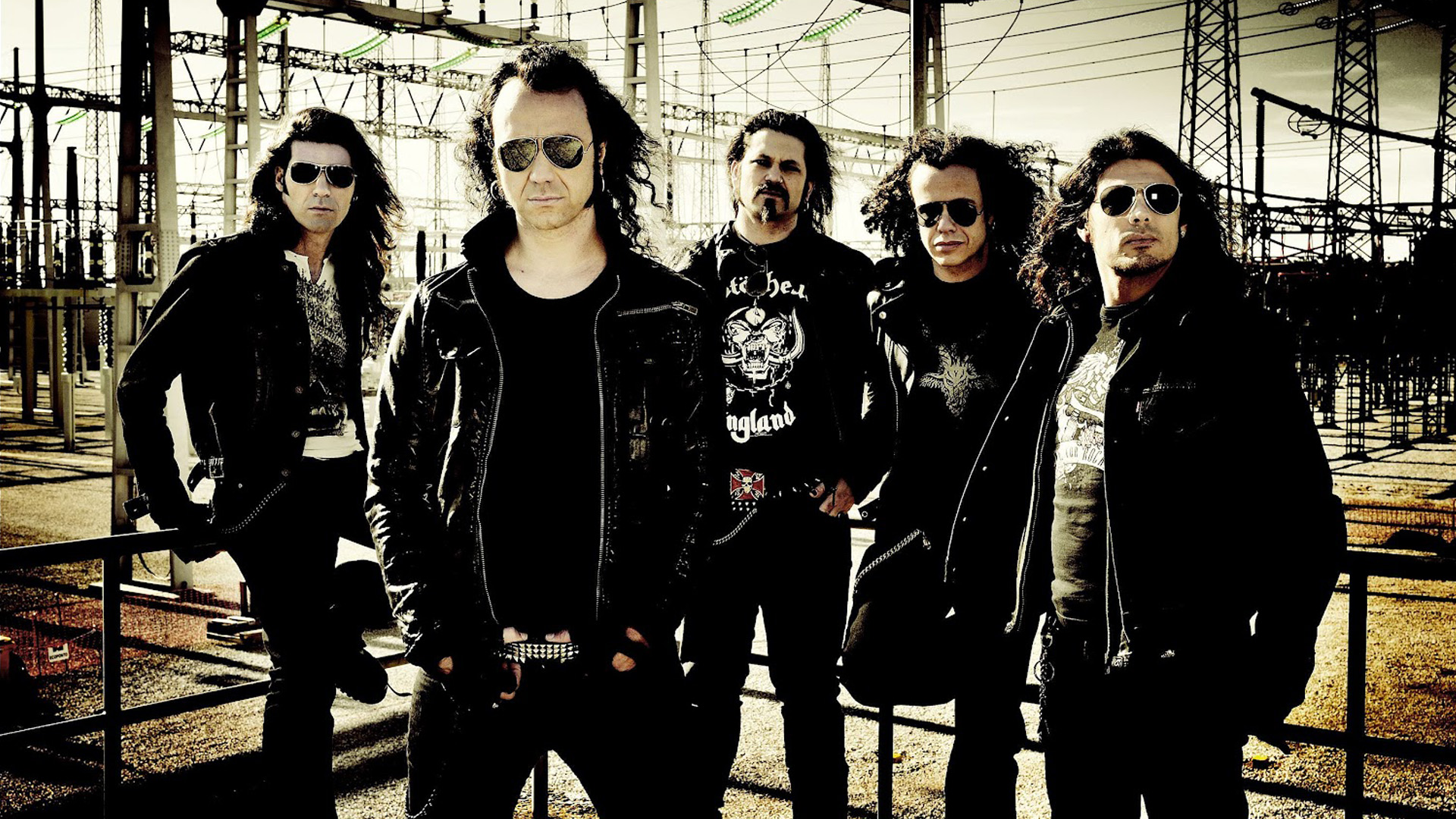
Moonspell with Fernando
Moonspell / face to face / Homepage: Facebook
First of all, welcome here to Summer Breeze in Germany. It's not the first time you've been here in Germany, so I hope you feel at home again.
Fernando: Definitely.
It's been a while now since your new album “Memorial” hit record stores worldwide, and you've had a lot of positive feedback. When I first listened to it, I thought about the title in combination with the music, and I came to the conclusion that the whole album is like a look back to the days when it all began, combined with a good portion of new material. So a step forward without forgetting Moonspell's roots. What do you think about that?
Fernando: I think you're absolutely right. Moonspell is music from the heart and from the soul. We don't think about which direction to take in order to please the fans or the media. With Memorial we got it pretty much right. It brings back the time when metal was very spontaneous and creative. That was when albums like “Wolfheart”, “Ceremony Of Opposites” or “Clouds” by Tiamat and Samael came out. Even though those albums were very different, they had elements that allowed you to identify with these bands. That's similar to what “Memorial” wants to be: an album that is traditional for this generation on the one hand, but takes people and the band further on the other. I think you've recognised that correctly, and I completely agree with your take on the album. Congratulations.
It's a real shame that there are no lyrics printed in the booklet. So I'm very curious about the themes on the album, because musically it covers a lot of ground. Tell us a bit about it!
Fernando: Um, it's a shame. I have to tell the label to include the lyrics at least in the promos, because for Moonspell it's not only the music that matters. I understand that it only becomes a complete thing when you hear the music and can read the lyrics at the same time. Only then do you understand the quintessence of the album. The lyrics are still quite classic for Moonspell. They still contain a lot of themes that are very close to my heart, and I never run out of sources for them. The album has lyrics about our obligations as Portuguese people; it has a lot to do with our country, because Portugal is a very enclosed country. There's the Atlantic and there's Spain. We're a small country and we're firmly hemmed in. We're people with different experiences, because we travel a lot with the band. But that feeling is still very intense for us. What's special about this album is its universal sphere. It's a very epic album, but on the other hand the stories in the songs can also be stories that a single person identifies with, and that's very important. I don't want to exclude individuals from listening to our music. Just as isolation can be something the whole tribe feels, or something felt by just one person. The lyrics have these two dimensions. They fit the music because they are written accordingly. Moonspell don't make music and then write the lyrics before or afterwards. Everything is real. Everything comes into being in one process.
One song I really like is “Mare Nostrum”. It has such a sad atmosphere. What inspired you for this song?
Fernando: It was very easy for us, because the song is strongly inspired by traditional Portuguese music. I wouldn't say folklore, more fado, more guitar music. All these songs have a lot to do with our relationship with the sea. Portugal, as you know, is a small country and we have about 900 kilometres of coastline. So the sea is always present in our lives. All these sounds, this melancholy, all these floating sounds remind us of the sea. “Mare Nostrum” translates as “Our Sea”. Basically we didn't have to go far, because we've been listening to these Portuguese guitar songs since childhood. We try to let them flow into our own music, because I believe that traditional music also has a lot to do with metal. Many bands like Amorphis, Finntroll and Bathory do this traditional thing, and Moonspell have always done it too – there have been quite a lot of songs like that.
They combine tradition with metal.
Fernando: Yes, exactly, and some of it is really good.
Does the sea mean a lot to you?
Fernando: Absolutely! It means a lot to every Portuguese person. If you're depressed and feel desolate, for example, most people in Portugal get into their car or onto the bus or whatever and drive to the sea, sit down there, look out at the sea and confide their secrets to it. It's a very romantic thing, but that's how it is. And if it's not the sea, then it's a river. We have this big river, the Tagus. For us it's a view of something familiar that has always been there. In fact, Portugal is only a well-known country because of the sea. Because we're so small, we've always had the urge to travel, to explore and to break through. And we use that trait in our music too.
In one of my favourite books I read the saying “There is no light without darkness”. I think there's some truth in that. Does this saying also apply to “Memorial”?
Fernando: Which book was that?
The Count of Monte Cristo.
Fernando: Ah, Dumas! A great book. I think that applies to Moonspell in general. Our name is very pagan-oriented. It's that simple, because the moon is the light in the darkness. It's something that reveals, and I think our music knows dark and melancholic sides first and foremost. I think spirituality can also lift you up.
There are these uplifting moments in it, and I absolutely agree – not only through the contrasts, but also through the possibility that they exist. That's why I don't believe anyone who claims to be completely gloomy or completely happy. I think you're a person first and foremost, and these two natures live inside you. Sometimes they fight each other, sometimes one or the other begins to exist. The Count of Monte Cristo really is a great book, and you can always learn great things from great books.
How come you decided to record only some vocals with a clean voice and most of the album with these “great and hateful vocals”?
Fernando: Around that time, and actually already on “The Antidote”, I decided to go back to screaming vocals, because the lyrics I write are stronger – more affirmative, real statements. I think I can be more emotional, and the hair on your back stands up more when I scream, because it really comes from the heart and it's not about building up an atmosphere as with the clean voice. To be honest, I'm not a great singer. I only sing because I write the lyrics, and my lyrics have these two natures. They're melancholic, but in their own way they're also very evil. So I decided to be this kind of singer. Sometimes viking, sometimes more goth. On “Memorial” the fast stuff consists of really aggressive songs. That's why there are more screaming vocals, but that doesn't mean I've given up my clean singing altogether. There are still songs like “Luna”, “Memento Mori” or “Best Forgotten” where that kind of singing is there, because those songs are more far-reaching and more melancholic. I think I'll stay true to this style – always a mix of both. Sometimes it's like the light in the darkness we talked about. Sometimes the dark vocals are stronger, sometimes the other vocals dominate.
As far as I know, you also write poetry. I've heard you've already written two books.
Fernando: The second book came out a few years ago. I'm currently finishing the third one. But the books are all in Portuguese.
Yes, unfortunately. Can you tell me a bit about them?
Fernando: I simply write a lot. I think that's poetry. It's like Jim Morrison said: he didn't want to write lyrics, he wanted to write poems. My favourite lyricists are poets too, like Jim Morrison, Nick Cave, Quorton of Bathory, Aaron of My Dying Bride, Dani of Cradle. If you imagine the music away – which of course you normally shouldn't do – you can see the lyrics themselves as poems. I just have a lot of ideas that wouldn't fit Moonspell's music, because we have a tradition. We have a style, and for it to fit the music you have to stick to certain rules. I simply write a lot of poetry, and that's what came out of it in the end. Then I found a good publisher, and now I'm already on the third book. The response has been really overwhelming. I don't do it because I want to be a writer, but simply because I enjoy it. It makes me feel good and relaxed. Just coming up with things from the gut. If I have the opportunity, why shouldn't I take it? My dream is to collect the three books and release them in English, German, Spanish, French, Italian – in every language – for Moonspell fans and people who are interested in what I write. That will definitely happen.
To come back to “Memorial”: there are two guest vocalists on it, a male voice on “At The Image Of Pain” and a really great female voice on “Luna”. Tell us a bit about the two of them. Could it be that I know the female voice from another Moonspell album?
Fernando: Sure you know her. Her name is Birgit Zacher and she's my vocal coach. She has a great voice and can also be heard on “Raven Claws” and on “Vampiria” with the scream. She's not really famous, but she's a great singer. I like people who give me a good feeling. We could have lots of guest musicians, maybe people from famous bands too, but for me Birgit is part of Moonspell as a band. We chose her for “Memorial” because everything fitted so perfectly. So we thought Birgit would be a great enrichment for the album, which she definitely is. She has a great voice.
The other guy isn't very famous either, but he's one of my favourite singers. His name is Big Boss and he sings in the Czech metal band Root. Even though not many people will know them, for me they're a fantastic band. Many musicians know them. I'm a big fan, everyone in Moonspell is a big fan. Adrian and Dani from Cradle are big fans too, as is Jensen from The Haunted. He's underground, but he has a great voice, and the best thing is that when we played the festival in the Czech Republic he came on stage with us at a really dark moment. He's not the kind of guest where you think “just somebody from some band”; these are real guests and they mean something to the band. So I hope they'll mean something to the people who bought “Memorial” as well. We didn't choose him because he's famous, but because he has this great voice and devotion to music.
Isn't it hard for you to put together a setlist for your live shows? You have so many old songs that everyone expects when you play.
Fernando: It's not hard, it's impossible, but we do our best. We play the most dynamic songs, and the most dynamic albums are Memorial, The Antidote, Irreligious and Wolfheart. When you play festivals, and especially when you're not headlining, like today, we get fifty minutes as a band that has released eight albums. It's very hard, but we try to sweep people along so that a very intense impression remains at the end, and we build our setlist around that. On “The Antidote” we had a very good setlist, and for this tour we tested a few possible combinations and now we have a very good setlist. We have songs from “Memorial”, the album we want to show people because it's the new album, but also old classics like “Alma Mater”, “Opium” or “Wolfshade”. Songs like “Vampiria” and “Mephisto” sometimes have to take a back seat when we play during the day, because they don't work so well in daylight. These songs need atmosphere, so they're more songs for shows in the dark. For daytime shows like this one we choose the harder metal songs. But we play most gigs indoors anyway.
As far as I know, you contributed to the soundtrack of a horror film. Tell us something about the film and the musical part you play in it.
Fernando: The film is called “I'll See You in My Dreams”, a Portuguese horror film. They wanted a band to do a zombie death metal march. The original song for it was a typical jazz song. It was really a lot of fun, and we played exactly what they wanted. We played a very brutal guitar, and we even shot a video clip for it. If you get the chance, you absolutely have to watch it on YouTube – Moonspell playing in front of an audience of zombies and then killing them. It's very cheap and low-budget, but it was a great experience. We like doing something new now and then, and it allowed us to help a friend who needed a band that could turn the song into what he wanted.
If I remember correctly, besides Moonspell you had another project called Daemonarch, which released an album quite a while ago. What became of it?
Fernando: You know, that was a secret band. I wanted to do it like Bathory in the early days – no interviews, not many pictures, which is impossible nowadays. But I did it, I released the recording. I didn't really care about promotion or sales, but people liked it and regarded it as a really great death/black metal album. For me it's simply an artistic project, something I also did because Moonspell were doing more melodic gothic stuff. But now there's no need for it any more, especially since Moonspell's new album, which comes across as very complete. But in music you never say never, and I think it was a great experience because it wasn't forced on listeners. Listeners embraced it because it was so spontaneous, and they couldn't believe it was so fast, so hard and so cold.
Can we ever expect anything new?
Fernando: No, it was just a project.
Can you tell us anything about the members of Daemonarch, or is that a secret?
Fernando: That's a secret. Some are obviously from Moonspell, but there were a few other people involved too. But I'm not allowed to say anything, because we did satanic voodoo – if I tell, I have to die (grins).
Tell us something about nature in Portugal. What's special about it and what does it mean to you?
Fernando: Portugal is different from the other European countries. I know this because I've travelled a lot with the band, and I see that the Portuguese have a unique mentality, especially because Portugal was fascist for 50 years, from 1924 to 1974. We missed all the revolutions and the modernity that developed in Europe. Then we had very extreme 80s, when we soaked up all the information at the speed of light, so that we became a country split between these two realities – very conservative, but also very modern. That's what our society is like. We can achieve great things – for example, important Portuguese NASA engineers solving unforeseen problems – but we can't manage to look after our own poor people or our own politics. It's a mixture of both. The country itself is very melancholic and dark, contrary to what people say. It's very different from Italy or Spain, because we had everything in our country, from the Visigoths to the Moors. So our culture is a mix of everything we learned from that. That created something very unique. I've met people who say we're completely different from the Spanish or the Italians, because it's a different country. As for nature – although there are many forest fires, which is a real shame and a nightmare for Portugal – we still have a very good connection with nature, and it isn't lost even though lots of shopping centres are now being built along the coast. That's making Portugal a very ugly country.
If I went on holiday in Portugal, what would I absolutely have to see, and why?
Fernando: You could stay there for a month, because Portugal is very compact. I think you should see Sintra, a medieval town outside Lisbon. It's very close by, and for example the film “The Ninth Gate” with Johnny Depp was shot there. There are old mystical palaces. Simply fantastic.
In every language there are important words you should know when you visit the country. In Germany, for example, “Bier” or “Scheiße”. Which Portuguese words should you know?
Fernando:
Fuck off – Foda-se
Cock – Galo
Shit – Merda
Hello – Olá
Thank you – Obrigado/Obrigada
How are you – Como está
Wine – Vinho
Okay, then I'd like to thank you for taking the time for this interview. I wish you lots of fun at your gig and enjoy the rest of the festival. We're already looking forward to hearing more from Moonspell. Or in other words: Muito obrigado pelo teu tempo!
Fernando: De nada. Thank you too, and sorry that we had to rush so much. Next time we'll definitely have more time, when we're on tour in Germany in January or February.