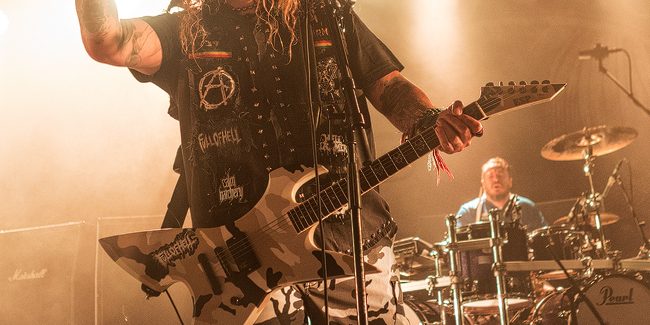
ASP with ASP and Matze
ASP / face to face / Homepage: aspswelten.de
First of all, I'd like to welcome you here at Summer Breeze and thank you very much for the time you're giving me.
ASP: You're welcome!
Summer Breeze is the last stop of your – let's just call it rock tour – this year. Would you say this festival differs a lot from the rest of the tour and the other festivals you've played, especially since it's a festival with a very broad musical range?
ASP: Well, it's different in many ways. Above all, it's different because we wanted to play this festival. It wasn't a request like “do you want to play here” or anything. We played here two years ago and simply said: that was great, we absolutely want to do that again. The people were great, the organisers do a damn good job, and we had the feeling that – even though you have to say we're not exactly speed metal – we were simply well received here.
No speed metal? Now you've really surprised me!
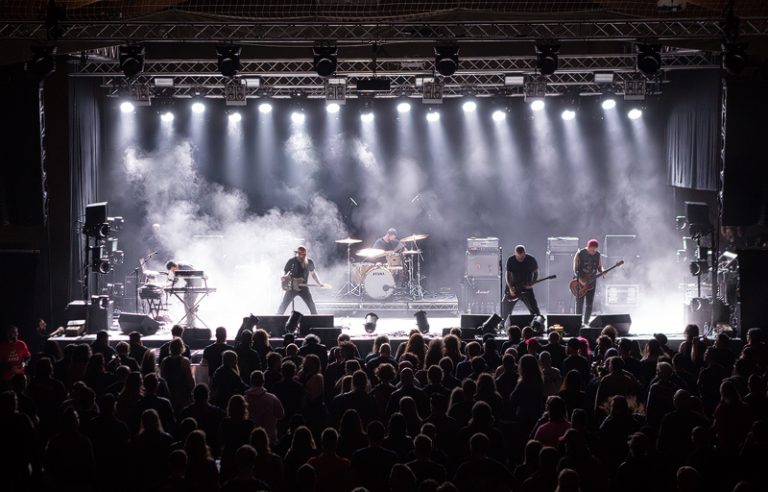
ASP: You'll see later (smiles). We were simply very well received here, and of course… with us there are always these decisions of the heart. Where it's no longer about money, where you simply say: these people have earned it, never mind, we'll come back. It has to happen. It's part of it now. And this festival was one of those things for us, so we also wanted to celebrate the end of our year here. I mean, a week ago we played M'era Luna, which is of course the biggest thing there is for the “black scene”, but it's nice to have this afterwards, where you can simply go on stage and say: now let's give it everything once more.
It really is a super broad mix here, definitely!
Matze: Every festival has its own character, you have to say that – and its own beer (smiles). The thing is, at heart we're probably much closer to the metal scene than people might believe or give us credit for. And that's probably why we have this need ASP was just talking about here, because it's simply incredibly fun to rock in this atmosphere. It's not only that the audience is great, it's also that the whole atmosphere backstage and the way people deal with music is simply infectious. It's very loving and warm – that's something you just want to have, and that's why we're here!
ASP: I think that may also have a lot to do with my personal musical development – I simply like these differences. I think there are two kinds of music in Germany. One runs in the charts and on the radio, and the other is music that is in some form “indie”. And within that there are several big currents, and I grew up with all of them in some way. So of course my influences – I'm a bit older – can also be found with Alice Cooper; I'm a big W.A.S.P. fan, for example. For me there are these influences on all sides. I also grew up with Maiden. On the other hand, it was a big revelation for me when I heard the Sisters Of Mercy for the first time. I always think that people who are so narrow-minded as to say you can't have both at the same time aren't real music fans. I listen to lots of different styles of music, because I think you should always be open. Matze, for example, also knows a lot about classical music, which helps us a lot – if you can call on those parameters, you already have a large musical repertoire. It's a pity that this is sometimes so hard to reconcile with a festival. But Summer Breeze is actually still very impressive in terms of the range of audiences it attracts, and we like that a lot!
It really is a very open festival, and all music lovers should be open too!
ASP: Yes, and we also have to say that what gave us the final push is that the local crew here is unbeatable. For musicians that's a really great thing – you arrive and everything runs so professionally, it's truly unique!
That's great, yes! If you look back and compare a smaller club show with a big festival – is there one you prefer, or is it simply a different approach depending on the venue you're playing?
Matze: It's absolutely true that the tour shows have a completely different character. You see the faces much more closely, you communicate differently with the audience, and that has its very own appeal. At festivals it's a completely different feeling. It's fantastic too – they're incredibly hard to compare. Emotionally, both are great.
ASP: We like both, and we enjoy playing both, but they're very, very different. I always have the feeling that a festival is a bit of a gamble: you go out, rock and try to show what you've got, and people either join in or they don't. That can depend on anything – on rain or sunshine, on everything. On an indoor tour, of course, our audience is there; they come to see us, and that's lovely. For us, the biggest problem at festivals really is the setlist. We have to think so hard about what we can play. For today we've once again had to drop songs because there's simply limited time, and that just hurts. On a tour, on the other hand, you can show everything you have, everything that matters to you. I think closeness to the people is also important – at a festival you don't even need to try. Here it's all about entertainment, so the setlist may look a bit different. We also try to use bigger gestures so that people at the back can still see us; you can't bring so much facial expression into play. But as I said, both are fun, as Matze already mentioned.
A completely different thing, clearly! Well, at least at a club show there are no real problems with the “sun curse” that seems to follow you. I experienced it live at the Feuertanz Festival – how do you explain this phenomenon?
ASP: I think it's a bit of an irony of fate. I think someone just wants to tell us: oh, so you're the guys in black, then the sun has to come out (smiles). No, no idea. We laugh about it by now, but there are also situations where you stop laughing and just think: I can't see anything any more! Because when we play, it's usually quite late in the evening, which means the sun is so low that you get it straight in your face. You can't see the people, you can't give any signals, you're flying completely blind.
Matze: In any case it's incredibly difficult to blame anyone, especially for us as atheists (laughs). Normally, when technical problems come up, you can give someone an earful, but with the sun that's difficult – you just have to accept it (laughs).
ASP: (sings) There is no God…
Matze: Maybe it's some kind of revenge, no idea.
ASP: So, you're atheists, are you? Lights on…
I'd almost see it that way too (smiles). I found a video interview from 2006 on the internet, in which you were interviewed during your first tour stop in my home town of Munich and talked about how people had advised you against playing in that city, because music like ASP's had no audience there. If you think about it, are there really regions in Germany that artists from the black scene tend to avoid?
Matze: Well, first of all, regarding that statement back then: that was a huge cheek. We've played Munich twice. We've played other cities much more often, and on our tour before last we had our best audience figures in Munich.
ASP: Tour record!
Matze: So it's simply been exposed as a booker's lie.
ASP: It's always the same. We say we want to go to Munich. Oh no, no, better not… The first time it was a very small club and it was very well attended, and the second time was so gigantic that we really said: aha. We felt confirmed in our decision to simply say no, no, Munich – we have to go there, we want to go there. That said, there are certainly regions you tend to avoid. What has actually emerged is that things go a tad better in big cities than in the countryside. Why exactly that is, we don't really know. No idea, it just shows a little. Maybe tolerance is a bit greater in big cities when it comes to guys like us.
Well, who knows (laughs)
ASP: Although, when I walk through my own neighbourhood at home, tolerance is pretty limited there too…
You're one of the few bands that still issue proper, beautiful tickets for their concerts, the way we know them from the old days, and that also place real value on album design, covers and the like. Would you say that, alongside the music, this plays an absolutely central role for you?
ASP: Yes! There are two reasons. On the one hand, of course, we aim to create an overall concept, a total work of art. On the other hand, Matze and I are both children of the 80s, I think, and when we really got a bit bigger in the music scene and were told that real hard tickets hardly exist any more, we said: but we'd like to have them, what are the options? When the answers were “there are no options” or “it can't be done”, we said: yes it can! We'll do it. It costs a pile of money, but we'll have them printed and do it, because we simply think it's beautiful. I think that, like most people our age, I have a box at home with all the concert tickets from the 80s and 90s in it, and I think that's a memory for life!
Exactly my opinion – I have that box too!
Matze: That's interesting – the other day I came across an internet blog about marketing strategies and the “new ideas” out there. It was really interesting to read, because everything described there as new had always been there for us. Only we never did it with the ulterior motive of clever, modern marketing, but simply with heart and soul. We want to offer people this, we want to do what we'd like to have ourselves, and that was very interesting, because maybe with the passion and love we put into it we're pioneers in some way. And all the desk jockeys come along afterwards and notice: ah, that works better somehow. And then they tell their clients something about credibility and so on. So it's simply what I said in passing just now: we do what we'd like to have ourselves. That sums it up best.
Do you as artists really have the chance to influence that yourselves?
Matze: Yes! We do! We make a point of staying independent.
With many big bands, everything gets handed over.
ASP: Well, okay, of course we also need people who do these things for us. But I think about two years ago there was a decision point for us, when really big companies were interested in us, and at some point we said: “If we'd wanted everything they're offering us, we'd have had to get on board 15 years ago.” We've been through long stretches of thirst and hunger, and now we simply do what we like – and that costs. It costs a lot of energy, because we have to do a lot ourselves and want to decide a lot ourselves. It really means you're on the indie track. And that means every one of these small decisions – do we do this or that or whatever else we think is good between the people and us – always costs something. We always have to make cutbacks elsewhere. But we're happy to do that, because I think we get thanked for it. I don't think there's a better feeling than when people grant you: they're for real. They do things you can still feel, and they don't just strike a pose.
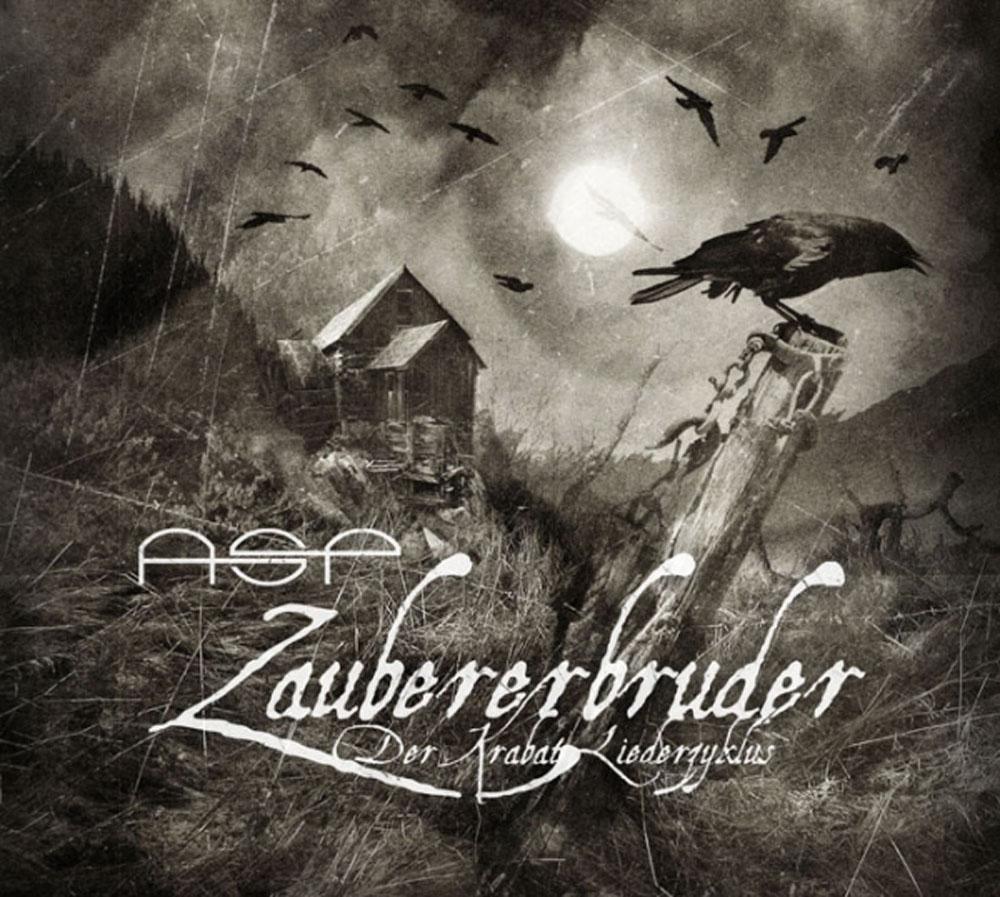
I think that's great, no question! Your album coming out this year will be called Zaubererbruder. You already started it with the four singles from “Ich bin ein wahrer Satan”. By now it's surely widely known that it's based on the story by Otfried Preußler, which in turn was based on a Sorbian folk tale. But how did you come up with this theme?
ASP: I have to say it's clearly one of my favourite stories, one I've always loved. And that's how most things happen: you grow fond of something, you feel it means a lot to you, and Krabat – by Otfried Preußler, or by Jurij Brězan – was one of those stories for me that leave you with a feeling of emptiness. Maybe you know that feeling too; with The Lord of the Rings, for example, when you've turned the last page, then – you're not supposed to say this – even real men cry. With Krabat I had the feeling that so much is still hidden in this story that you might simply have to dig deeper, and since it actually is a legend, at some point the decision was made. We started close to Preußler and then researched very widely to see what else there was. It was hugely exciting, but the album that came out of it is also something completely different. There are folk influences in it, which of course follows from the context. That doesn't mean we only want to do folk and unplugged from now on. There are also a few real hammers on it that rock nicely. We're simply curious how it will be received. We got to take on a musical challenge, we tried it, and I think the album has turned out very beautifully!
Matze: Once again it's our most varied album (laughs). And – one man's joy is another man's sorrow – the least electronic. The most guitar-driven, the most honest and the… people always talk about real instruments, which I find a bit tricky, but let's say it has lots of real instruments (laughs).
ASP: It's certainly not the most rock-oriented, because there are a lot of ballads on it. That simply follows from the story. Of course we also have a few rock songs that really get down to business – maybe even more so than before. But I wouldn't say it has become a typical rock album. In the end the story simply offers many more quiet moments than hard ones, and we tried to do justice to every scene, every chapter of this story. But there's the track “Denn ich bin der Meister”, for example, which is very rocky, and then we also have a track that runs almost 12 minutes, called “Verwandlung”. It gets down to business like no ASP track before.
Nice! The original is about the orphan boy Krabat, who is taught the black art, magic, at the black mill. I'd be interested in your opinion on the word magic, which is used quite often these days – how would you define it?
ASP: Hmm (laughs). I have to admit I'm absolutely no friend of esotericism, and when people use the word magic it usually has an esoteric ring to it. Every other woman is an initiate, along the lines of: I had a dream last night and now I'm a magician… I'm very, very careful there. For me, magic exists on a different level. The things I call magic are when Matze and I have absolute stellar moments in the studio, where we understand each other blindly. Where I think energies flow between people when you get on well, when suddenly something happens and you say: whoa, that's it! Something great just happened here. That's love, of course, but also friendship! That's creativity. That's what magic is for me – in my belief it has relatively little to do with the supernatural.
Absolutely – a good and beautiful definition!
ASP: Thank you!
What does literature mean to you? Inseparably linked to music?
ASP: For us, of course, it means a lot. I mean, at some point we also gave ourselves our own label with this “gothic novel rock”. That was mainly because at some point people denied that we were a gothic band. That gets said very often and we don't care. We're strongly influenced by the literary gothic tradition – whether it's Byron, Shelley or Poe – and storytelling is very much at the forefront for us. Lyrics play a very important role, which I think automatically made us unique in a way, because lyrically we often feel we can offer something that many bands who perhaps sell ten times as many records as we do don't even want to offer. Not because they can't, but because they don't want to. Maybe we've found our niche there, and that's our kind of gothic.
Matze: What I find really awesome is the challenge when I do arrangements, or when we do arrangements together and develop songs. ASP writes lyrics that are usually small stories within a big one. And I find it fascinating that every story has an inner dramaturgy, an inner tension. Unfortunately, these days it's very common to put out static statements. Like saying: my boss is an arsehole, or whatever. Or whatever general nonsense gets bleated out. But when you set a story to music, you have an inner tension, a dramaturgy, a finale, climaxes and big moments, and realising that is of course a much bigger challenge than simply saying: that's catchy, so let's sing the chorus another eight times… That's what's great about having this connection – it inspires the music very strongly.
More demanding and more unique, definitely! Does one of the two take precedence over the other?
ASP: No, both equally. It's not about precedence. I think what we want is to create the magical connection between the two. So that at some point you feel this fusion of music and lyrics is inseparable. A big challenge that is very difficult – especially when you have a lot to tell! But we do our best.
Matze: Sometimes you blank it out – sometimes you blank out the lyrics and say the music really rocks now, or you say: ah, now I'll concentrate a bit on the story. So you can't say one takes precedence; both should be perfect!
Nice. In one of my favourite books – The Count of Monte Cristo – there's a saying that you can only feel true joy if you have also felt the deepest sorrow. What do you make of this quote?
ASP: Oh! I can only agree with the man! That's my life motto! And vice versa. I believe that taking the highs and lows of life with you on your way is what really makes you human; it really makes you feel deeply. It makes you live deeply, and that's a lot of what my “blackness” is to me. In everyday life, simply saying: I perceive and take in the melancholic and negative sides just as much – and in return I can also be glad, happy and cheerful.
Matze: ASP wrote this incredibly beautiful, well-known line: only those who open themselves to pain also let love in. In “Und wir tanzten”. That's a comparable statement, and I can only agree with all of it!
My opinion too! I found it very interesting to dig around on your website a little, and in the FAQs I came across the question “Why am I not allowed to take photos at ASP concerts?”. I found your answer very interesting – it began by saying that you're children of the 80s. That almost sounds a little wistful with regard to many customs and innovations that have come about over time?!
ASP: (laughs) Er, how much time have you got?
(laughs) Oh, I've got plenty of time – and you?
ASP: To keep it really short: we simply don't understand the outcry, with everyone suddenly saying: but why of all bands can't you take photos at your shows, why not? When I go to concerts, you're not allowed to take photos. That's how I know it. And of course it's also true that as musicians we're already peddling our wares these days, that everything has become harder anyway with internet downloads and so on and so forth. We play somewhere, and two minutes later – no matter how strict the checks are – the concert is up on YouTube. Great, that's really wonderful for us!
Really harsh, yes!
Matze: Yes, maybe you could say the music we make is simply cooler than we look, somehow… (laughs)
ASP: You could also say the music is a lot cooler than we look!!
Matze: (laughs) That's why listening is the nicer sensory experience.
I can absolutely understand you, and even as a member of the audience I find it absolutely terrible when all I can see in front of me is a sea of raised mobile phones – it's awful!
ASP: Less than a month ago I went to a very exclusive concert by Loreena McKennitt, if that rings a bell. An outstanding artist, everything has to be just right, everything has a very classical touch. You go to an evening soirée, and in front of me was a person who was taking photos with their phone the whole time, and I simply have to say: that ruins the concert for me. It makes me want to go home.
Absolutely, I feel exactly the same!
ASP: We simply want to limit it a little more. We're always a bit trapped – we want to be fan-friendly, we want people to have fun and take everything home with them, but I simply believe that a memory captured by phone photography isn't half as great as what you somehow…
What you take home in your heart?
ASP: What you take home in your heart, exactly!
Matze: Yes, you just have to take the time to do that, and not spend the whole time looking at the photo!
Yes, then you have no time left for the concert itself!
ASP: Yes, that really is a problem. Of course we can't try to lecture everyone like schoolmasters and say: hey, it's much better if you don't look at the screen but simply watch what's happening on stage. We can't prevent it, and we can't ban people's phones either – that's impossible. But it will bring much bigger problems in the coming years, because at some point the quality will be so good that live CDs will die out. Anyone can somehow let their own recording run on their phone. We don't want to be as gloomy as many of our colleagues, because I think the connection between band and fans counts for a lot, but it won't be easy, especially in the indie sector. The music business is like a pyramid: at the top sits Herbert Grönemeyer in Germany, and then come all the others. The pyramid gets wider and wider, and somewhere at the bottom we sit as an indie band. And that's the first thing to break away when the market no longer works. It's a really stupid saying, but diversity will suffer, and all that will remain is free on MySpace and nothing but a hobby!
Yes, unfortunately! Which is a great pity in my eyes!
ASP: Maybe it's a big cleansing, but the problem is that it never hits the majors. Whatever you do!
The ones who might need to go so that something new can come along!
ASP: Er, no comment (smiles). No, actually, every comment: the major record labels have done everything wrong for the last twenty years and are still collecting the reward for it today – and that can't be right!
Exactly my opinion! That's actually almost my next question already. You've felt the harshness of the music business more than once. Don't you sometimes feel that you almost lose the joy of the actual thing – the music?
ASP: Oh, good question at the right moment! Yes, that has happened very often recently! But the problem is, we can't do anything else. We always think: that's really enough now, and now… I can't speak as freely as I'd like, but we keep getting stuff shoved at us that we don't want. But then there are the moments when we simply say: okay, how do we deal with situations now, what do we do – and in the end we realise: well, we just have to keep fighting. That's part of being a musician. We have no choice, because I think both Matze and I know we can't do without it. Two years' break and we'd be right back here.
Matze: In any case it's one more reason to get bigger. To give back more of everything you've had to take (laughs).
ASP: These days you have to be more independent as a musician. You can't really have anything taken off your hands any more. You can no longer say: we want this label, we want this agency – you really have to do everything yourself. As well as you can, in some form. Or find partners who really… let's say share the vision, then it works. And only in the indie sector, not otherwise.
Yes, as soon as you move more towards the mainstream, towards a major, that's over!
Matze: Turning down majors has actually become one of our favourite hobbies!
ASP: Yes, that keeps us going a bit (laughs)
That keeps you young and fresh (laughs)
ASP: Yes, our common enemy, haha!
Your upcoming tour won't be a rock tour, but a purely acoustic tour. Are there particular reasons for that?
ASP: It's simply a nice thing to present yourself that way too. Of course we always want to show a bit of what we can do musically. We feel there's room for that side too, where people get to hear things. There are two souls living in one breast. As a musician you'd like to shine sometimes, and you'd also like to rock out freely. We try to be able to do both, but sometimes that's a new challenge too. We'll have some great guest musicians with us who will give the music a very beautiful colour – who will challenge Matze as an arranger in completely new ways. I'm really looking forward to that! And it's unforgiving. You go on stage, and it forgives nothing. Especially as a singer I can say: oh my God, every wrong note will be heard by every one of those 800 people sitting reverently on their chairs. And I'm responsible for that. Er, why did we want to do this again, Matze (laughs)?
Matze: I don't know… To come full circle: we refuse to be one-sided and to be a pigeonholed band, because we love music in too many directions…
ASP: Are you referring to our swing record now (laughs)?
Matze: Right, exactly… the one right after the, yes… (laughs). It's simply also great to do something like that. That's why there's one kind of tour sometimes and another kind now. And we'll be rocking again and going full throttle soon enough!
ASP: We know what it's like – we did an acoustic tour once before, and after fourteen days unplugged we felt like getting the guitars out and rocking!
Which I think is an absolutely great closing statement! Versatility is everything – I think so too! Thank you very much for your time, it was a pleasure!
ASP: You're welcome!
Matze: Thank you!